Seven years ago, a foldable phone was still a leap of faith — a device that review units couldn’t even survive a week of daily use, a category everyone was curious about but nobody quite trusted. Samsung took that leap anyway. It bet an entire product line on the idea that a screen could crease down the middle and still feel like the future. Today, that bet has matured into an industry, and the industry has just gotten its second major player. Apple is finally here.
To everyone who has watched India’s smartphone story shift — from a market obsessed purely with price, to one now willing to pay for the exotic — this moment matters more than a single product launch. It’s the moment two of the most valuable companies on the planet finally go toe-to-toe on the same battlefield, in the same shape factor, in the same market. And the market they’ve chosen to fight hardest for is us.
Seven Years in the Making
Apple announced its first-ever foldable, the iPhone Duo, on September 9, 2026 — a device the company clearly did not rush. At 5.2mm thick when unfolded, wrapped in Grade 5 titanium with a precision hinge, protected by Ceramic Shield 2 and rated IP68, it is, by any measure, an engineering flex. A 5.4-inch OLED cover display and a 7.6-inch inner Super Retina XDR panel, both running 120Hz ProMotion at up to 3,000 nits, sit on either side of that hinge. Under the hood, the new A20 Pro chip — built on 2nm technology — promises a CPU up to 20% faster and a GPU up to 40% faster than last year’s A19 Pro. A 48MP Dual Fusion camera system and dual batteries good for up to 31 hours of video on the inner screen round out the package.
None of it comes cheap. In India, the iPhone Duo starts at Rs 2,99,900 for the base 256GB model and climbs to Rs 4,49,900 for the 1TB version — in just two colours, Star White and Night Sky. Put next to Samsung’s Galaxy Z Fold8, which starts at Rs 1,79,999 for the same 256GB storage, Apple is asking Indian buyers for roughly Rs 1.2 lakh more for the privilege of folding an iPhone. That is not a rounding error. That is a statement of exactly who Apple believes it is selling to.
The Mountain Samsung Built
Here is the number that should humble anyone assuming Apple simply walks in and takes over: Samsung currently commands 89% of India’s foldable smartphone shipments. Motorola holds another 8%. That leaves everyone else — Apple included — fighting over the scraps of a single-digit remainder, with analysts projecting Apple will account for less than 1% of India’s foldable market in all of CY2026.
That is not a knock on Apple. It is a tribute to what Samsung built, quietly and patiently, over seven years of iteration — through a first-generation Galaxy Fold that genuinely struggled, through generation after generation of hinge redesigns and display improvements, until “foldable” stopped sounding like a gimmick and started sounding like a category Samsung simply owned. To the engineers and product teams who kept betting on this shape when the easier, safer choice was to walk away — this dominance was earned, not inherited.
India’s foldable market itself is still a rounding error in the country’s overall smartphone story — projected to cross 650,000 units in CY2026, with cumulative shipments expected to pass 3 million by year-end, up from 2.5 million at the close of CY2025. It is growing at 8% even as the broader smartphone market contracts by 13-14%, yet it still accounts for only 2-3% of the market by value. Small, yes. But it is exactly the kind of small that premium brands fight hardest over, because the average selling price for a foldable — around $1,800 — runs roughly five times that of a typical smartphone.
And prices, industry watchers warn, aren’t coming down any time soon. As Counterpoint analyst Shubham Singh put it, “higher production volumes alone are unlikely to bring down prices” — rising memory costs are seeing to that. Every player in this category, Apple included, is going to have to earn its share the hard way, at a price point that keeps this a rich person’s category for a while yet.
What the Rest of the World Sees Differently
Zoom out from India, though, and the picture shifts. IDC’s global forecast has the iPhone Fold capturing 22% of unit share and a striking 34% of foldable market value in its very first year worldwide — a number that would make any newcomer’s entrance look less like an experiment and more like an arrival. IDC expects that value share to hold near 34% through 2029. Globally, the foldable category itself is forecast to grow nearly 30% in 2026, and Apple’s entry is a big reason why.
That gap — a company projected to own barely a sliver of India’s foldable shipments this year, while commanding over a third of the category’s value worldwide — tells its own story about India. Indian buyers, even the ones who can afford three lakh rupees for a phone, are not simply going to switch loyalties because Apple finally showed up. Brand trust in this segment was built one generation at a time, on Indian soil, by a company that never stopped showing up for it.
What This Means for Us
Whatever happens to the market-share numbers over the next few years, something has already changed for good: the foldable phone is no longer a Samsung experiment that the rest of the industry watches from a distance. It is now a contest between the two most consequential consumer tech companies on earth, and Indian consumers are, for the first time, being asked to choose a side in that contest at home, not just read about it happening elsewhere.
For the shopper walking into a store in Hyderabad or Mumbai or Bengaluru next month, that choice will come down to something simpler than specs on a page — do they trust the company that built this category from nothing, or do they pay a premium to be among the first to fold an iPhone? Either way, competition like this rarely stays quiet for long. Prices eventually move. Designs keep improving. And a category that once felt like a novelty for the very few starts, slowly, to feel like it might one day belong to everyone.
That’s the real headline hiding under all the spec sheets and price tags this week — not who wins the first round, but that there’s finally a real fight worth watching.
Reporting based on coverage from Moneycontrol (https://www.moneycontrol.com/technology/apple-vs-samsung-unfolds-can-iphone-duo-break-galaxy-s-foldable-stranglehold-in-india-article-14027785.html), Business Standard, The Tribune, and Tom’s Guide/IDC.
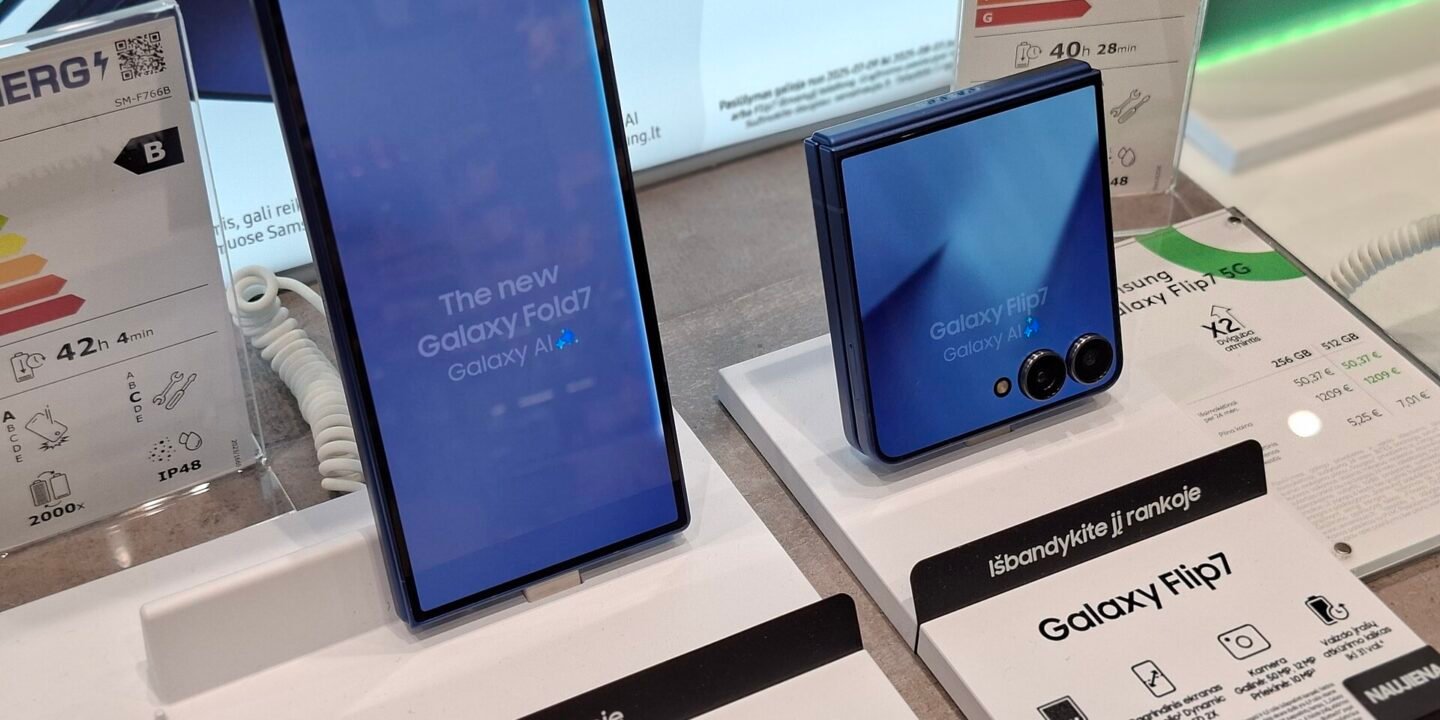
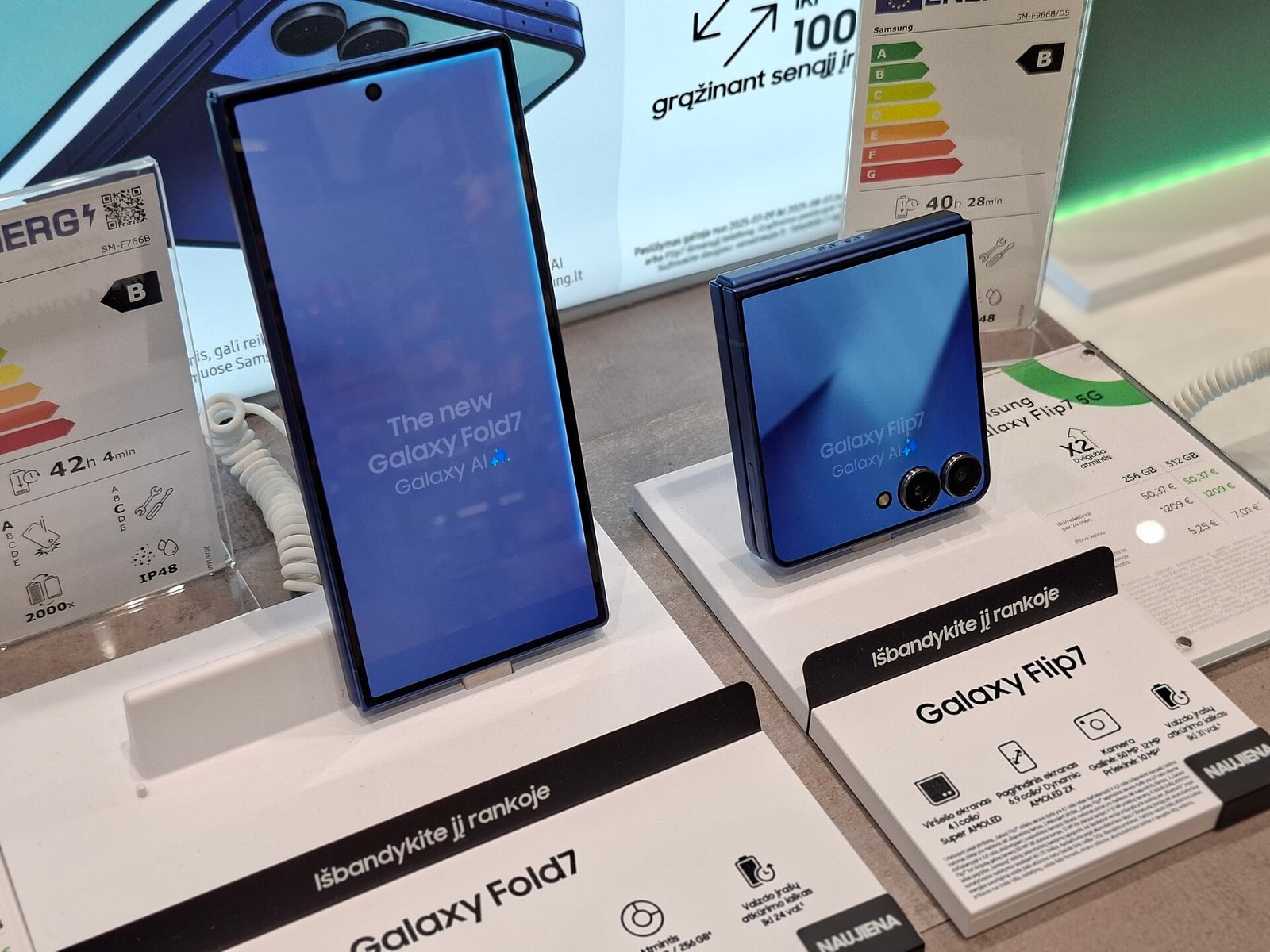
Photo: Samsung Galaxy Z Fold 7 and Z Flip 7 on display in a phone store, by Matabalt (CC0, via Wikimedia Commons).