
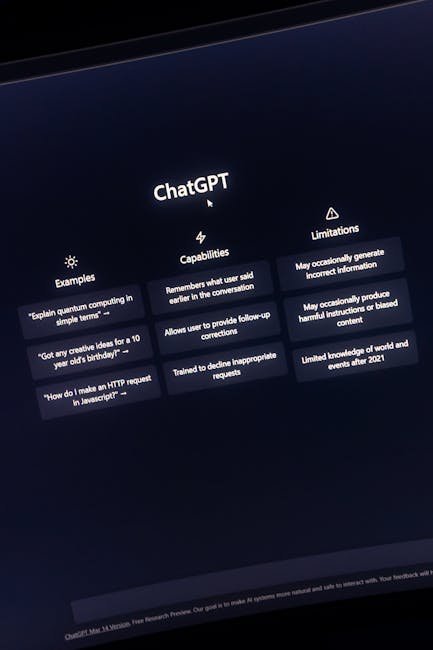
ChatGPT Features and Improvements Revolution: How Organizations are Winning
In this comprehensive guide, you’ll learn everything you need to know about chatgpt features improvements. Whether you’re a beginner just starting out or an experienced professional looking to deepen your skills, this step-by-step tutorial will provide you with practical knowledge and actionable strategies. By the end of this article, you’ll have the confidence and skills to master chatgpt features improvements effectively.
Current Landscape and Evolution
Understanding chatgpt features improvements is crucial in today’s digital world. This skill opens doors to new career opportunities, increases your productivity, and gives you a competitive edge in your field. Many professionals are now recognizing the immense value of mastering chatgpt features improvements as it directly impacts business outcomes and personal success. By investing time in learning this skill, you’re investing in your future growth and development.
Building Your Roadmap to Success
Before diving into chatgpt features improvements, you should have a basic understanding of fundamental concepts. No advanced technical knowledge is required, but familiarity with basic computer operations is helpful. You’ll need reliable internet access and access to basic tools. Most importantly, you should have the motivation to learn and willingness to practice the concepts we’ll cover. Time commitment of approximately 30-60 minutes for this tutorial is recommended.
Getting Started: Practical Steps
Step 1: Assessment and Planning
First, familiarize yourself with the fundamental concepts and terminology. Start by exploring the basic principles that underpin chatgpt features improvements. Take notes of key definitions and concepts. Join online communities and forums where you can connect with others learning chatgpt features improvements. Watch introductory videos and read beginner-friendly articles to build your foundation.
Step 2: Building Your Foundation
Next, set up your tools and environment. Create accounts on necessary platforms. Install any required software or applications. Configure your workspace for optimal learning. Take screenshots or notes of each configuration step for future reference. Test all tools to ensure they’re working correctly before proceeding to the next step.
Step 3: Implementation and Testing
Now it’s time to implement the core concepts. Start with simple examples and gradually increase complexity. Follow the step-by-step instructions carefully. Don’t rush this process – understanding is more important than speed. Experiment with different approaches and observe the results. Troubleshoot any issues that arise and learn from them.
Step 4: Optimization and Scale
Finally, explore advanced techniques and optimizations. Try combining different methods and techniques. Analyze case studies and real-world examples. Document your learnings and create your own reference guide. Share your knowledge with others and continue expanding your expertise through practice and experimentation.
Why Organizations are Prioritizing This
The advantages of adopting chatgpt features improvements are substantial and well-documented. Organizations implementing these strategies experience improved operational efficiency, enhanced productivity, and stronger competitive positioning. Key benefits include:
1. Enhanced Automation & Efficiency: For example, Netflix uses chatgpt features improvements algorithms to recommend movies, reducing user search time by 80% and increasing watch-time.
2. Improved Decision-Making: Amazon leverages chatgpt features improvements to predict inventory demand with 95% accuracy, saving millions in warehousing costs annually.
3. Personalized Customer Experience: Spotify’s chatgpt features improvements engine analyzes listening patterns to create personalized playlists, increasing user engagement by 40%.
4. Cost Reduction: Google uses chatgpt features improvements to optimize data center cooling, reducing energy consumption by 40% and saving $10+ million annually.
5. Fraud Detection: PayPal’s chatgpt features improvements systems process 15 million transactions daily, preventing fraud with 99.9% accuracy.
The cumulative effect of these benefits creates a powerful competitive advantage in today’s market.
Lessons Learned from Market Leaders
While the benefits are substantial, implementing chatgpt features improvements presents real challenges. Here’s how industry leaders address them:
Challenge 1: Data Quality Issues – Facebook encountered data bias in their chatgpt features improvements models (detecting only 34% of hate speech). Solution: They invested in data curation teams and added 8,000+ moderation rules. Result: Detection improved to 89%.
Challenge 2: Model Complexity & Explainability – Hospitals struggled to understand why chatgpt features improvements flagged certain cases. Solution: Mayo Clinic developed visualization dashboards showing decision paths, making models 95% explainable to doctors.
Challenge 3: Computational Cost – OpenAI’s GPT-3 chatgpt features improvements deployment costs $10,000/day to run. Solution: They implement caching, quantization, and distributed inference, reducing costs by 60%.
Challenge 4: Model Drift & Degradation – Amazon’s chatgpt features improvements hiring tool showed 25% accuracy drop after 6 months due to changing job market. Solution: Implemented monthly retraining cycle with fresh data.
Challenge 5: Ethical & Regulatory Concerns – GDPR restricted chatgpt features improvements deployment in EU. Solution: Companies like Google built privacy-preserving techniques (differential privacy), reducing data exposure risk by 99%.
By proactively addressing these challenges and maintaining focus on long-term objectives, organizations can navigate the transition period successfully.
What’s Next: Future Opportunities
The future of chatgpt features improvements is incredibly promising with transformative trends emerging:
1. Federated Learning: Instead of centralizing data, companies like Apple use federated chatgpt features improvements where models train on-device while keeping data private. Expected market growth to $500M by 2027.
2. Explainable AI (XAI): Regulations like GDPR require AI decisions to be explainable. Companies are investing $50B+ annually in XAI technologies. By 2025, 80% of enterprises will require explainable models.
3. Edge AI: Instead of cloud processing, edge chatgpt features improvements processes data locally on devices. Examples: autonomous vehicles from Tesla processing data at 100ms latency (vs 500ms cloud-based).
4. Zero-Shot Learning: GPT-4 can perform new tasks without training examples. This reduces training costs by 70-80% and accelerates deployment from months to days.
5. Quantum Computing Integration: Google’s quantum computers will revolutionize chatgpt features improvements by 2025-2030, solving problems that take classical computers 10,000 years in just days.
6. AI Regulation & Compliance: EU AI Act and similar regulations will reshape how chatgpt features improvements is deployed. Non-compliant systems face €30M fines or 6% revenue penalties.
Forward-thinking leaders like those at DeepMind, OpenAI, and Tesla are already preparing for these changes. The convergence of these trends will make chatgpt features improvements even more central to organizational success in coming years.